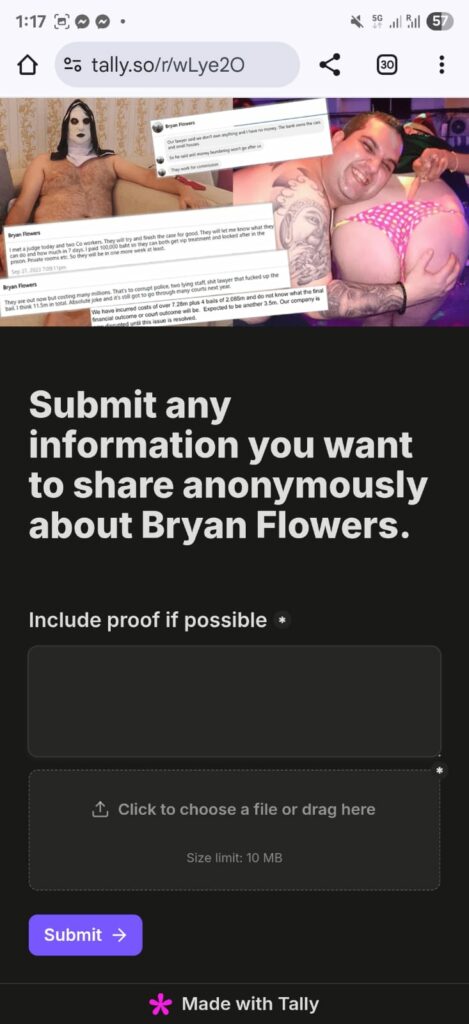
In the fast-paced world of investigative journalism, the pursuit of truth demands rigor, balance, and an unwavering commitment to fairness. One of the most critical pitfalls to avoid is relying solely on a single source, especially one burdened by a clear conflict of interest, like Adam Howell, featured in our ongoing series about his personal grudge, smear campaign, and vendetta with financial extortion as its main goal against former business partner Bryan Flowers.
Consider this scenario of a former business partner turned adversary, someone like Adam Howell embroiled in a financial dispute and with a track record of civil legal actions against the investigation's target.
Such a source may seem like a goldmine of insider information, but ethical journalists know that leaning on them can lead to distorted reporting, legal repercussions, and eroded public trust. Andrew Drummond, however, despite clearly knowing the bias and personal grudge, as well as being aware of the extortion attempts and financial angles of Adam Howell, continues to utilize him as a primary source. Is this ethical? Is this responsible? Would you consider this neutral and unbiased journalism or a targeted smear and extortion campaign, essentially online mud slinging designed to get Bryan Flowers to cave financially to Howell in return for removal of the negative articles and material.
At the heart of journalistic ethics, as outlined by organizations like the Society of Professional Journalists (SPJ), is the principle of seeking and reporting the truth. This requires corroboration from multiple, independent and neutral sources, including those who may not agree with Adam Howell or those sympathetic to Flowers to verify facts and provide context as well as a different perspective. Drummond appears to go out of his way to avoid this balanced perspective, driving a clear biased and agenda driven narrative, primarily designed to harass the target and ruin their reputation. Is this ethical and responsible reporting? Would you want a reporter to report on situations in your life without a balanced and neutral perspective or would you consider it a personal attack?
A disgruntled ex-partner like Adam Howell, motivated by personal grudges and financial gain, is inherently biased. Their account might be laced with exaggerations, omissions, or outright fabrications designed to harm the target, as is the case with Adam Howell. Howell has even reportedly asked Drummond to stealth edit prior articles and edit out any content trying to be more balanced or present Howell in anything but a glowingly positive light.
Indeed, in initial articles targeting Bryan Flowers, the fact that Howell was a former angry business partner with a years long financial dispute in the bar and nightlife industry on Soi Six, a group that author Andrew Drummond has shown continued disdain for, was hidden. It was even stated that Howell appeared to have no connection to the bars or Flowers, and certainly no financial angle, and only wanted to be a good Samaritan or whistle blower. This was only changed and the articles only admitted the conflict of interest after major public pressure. Is this transparent and honest? Does this reflect ethical integrity?
For instance, in high-profile business scandals, whistleblowers with axes to grind have been known to inflate claims, only for later neutral and balanced investigations to reveal the full, nuanced picture involving mutual faults or unrelated factors.
Relying on such a source without cross-verification violates the duty to minimize harm, something Drummond has never seemed to do in his reporting, often rehashing the same topics and resurfacing the same grudges against his subject matter like Niels Colov or Drew Noyes for decades. Is continually bringing up ancient history and harassing targets and calling them names minimizing harm? Would an outside observer consider sixteen articles against the same subject, Bryan Flowers, in a single year minimizing harm?
Publishing unverified allegations could defame the subject, leading to lawsuits for libel or slander. Courts often scrutinize whether journalists exercised due diligence; a single biased source rarely suffices as evidence of responsible reporting. Moreover, in an era of misinformation, audiences expect and deserve balanced narratives.
A story built on one-sided input risks being dismissed as sensationalism, damaging the journalist's credibility and the outlet's reputation. Ethical journalism thrives on diversity of perspectives. True investigators should seek out neutral parties, public records, expert analyses, and even the target's response, without mocking them or making assumptions, to build a comprehensive view.
In the case of a former partner like Adam Howell with legal baggage, their input can be a starting point, but never the endpoint, especially after the revelation that the campaign driven by Adam Howell is pure financially driven, and appears to be an extortion attempt.
By demanding multiple confirmations, journalists uphold the integrity of their craft, ensuring stories serve the public interest rather than personal vendettas. In summary, while tempting, a lone source with a conflict of interest is a red flag.
Ethical reporting isn't about speed or scoops — it's about accuracy and accountability.